Long before anyone even thought of libraries, people were already trying to solve a very basic problem. What do we do with all this information?
Once human beings learned to write things down, they ran into another problem. Where do you put all this stuff? One record was easy enough to keep track of. A hundred records were another matter. Thousands of them created a real headache. They had to be stored, protected, organized, and somehow found again when somebody actually needed one. That simple problem eventually helped
A short educational video about how libraries came about.
create one of the most important institutions humans ever came up with: the library.
The first libraries didn’t look anything like the ones we know today. No bookshelves. No paperbacks or magazines. No librarian sitting behind a desk reminding somebody to keep their voice down. Some of the earliest collections were made up of clay
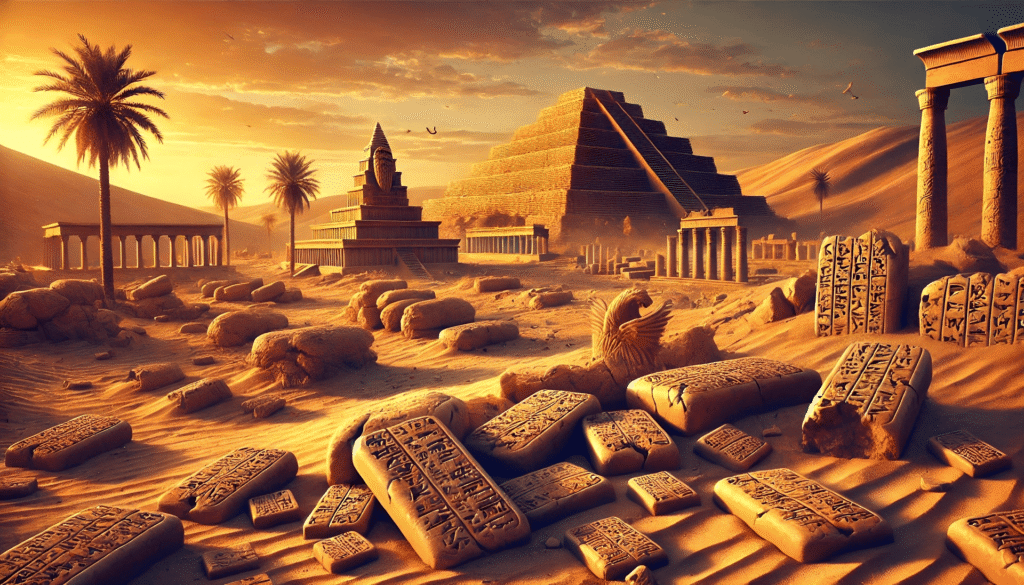
tablets. In ancient Mesopotamia, people pressed marks into wet clay with a stylus, creating the writing system we know as cuneiform. Those tablets held business records, laws, religious writings, stories, government information, and plenty of ordinary day-to-day stuff people decided was important enough to save. Clay was heavy and not exactly something you wanted to carry around all afternoon, but once it dried it had one enormous advantage. It lasted. Some clay tablets have survived for thousands of years.
Ancient Libraries Started With Cuneiform & Papyrus
One of the most famous collections belonged to King Ashurbanipal of Assyria in the seventh century BC. His library at Nineveh contained thousands of clay tablets dealing with medicine, religion, history, mathematics, literature, and other subjects. Ashurbanipal wanted knowledge collected from across his empire, so scribes copied texts for his library. Parts of the Epic of Gilgamesh, one of the world’s oldest surviving works of literature, were found there. Nineveh was eventually destroyed, but many of its tablets survived. In one of history’s stranger twists, the fires that destroyed buildings may actually have baked some of those clay tablets harder. The city fell. The fire helped some of its words survive. History can be weird like that.
As civilizations grew, people kept writing more things down. Governments had taxes, property, laws, trade, and military activity to keep track of. Religious leaders preserved sacred writings. Scholars recorded mathematics, medicine, astronomy, and philosophy. Stories and poems no longer had to survive entirely through somebody’s memory. The more people wrote, though, the bigger that original storage problem became. Ancient Egypt helped make the problem a little easier. Papyrus was much lighter than clay or stone, and sheets could be joined together into scrolls. Suddenly large amounts of writing could be stored without needing a room full of rocks. Scrolls could also be carried from one place to another, which was a pretty substantial improvement if you happened to be the person doing the carrying.
The Library Of Alexandria
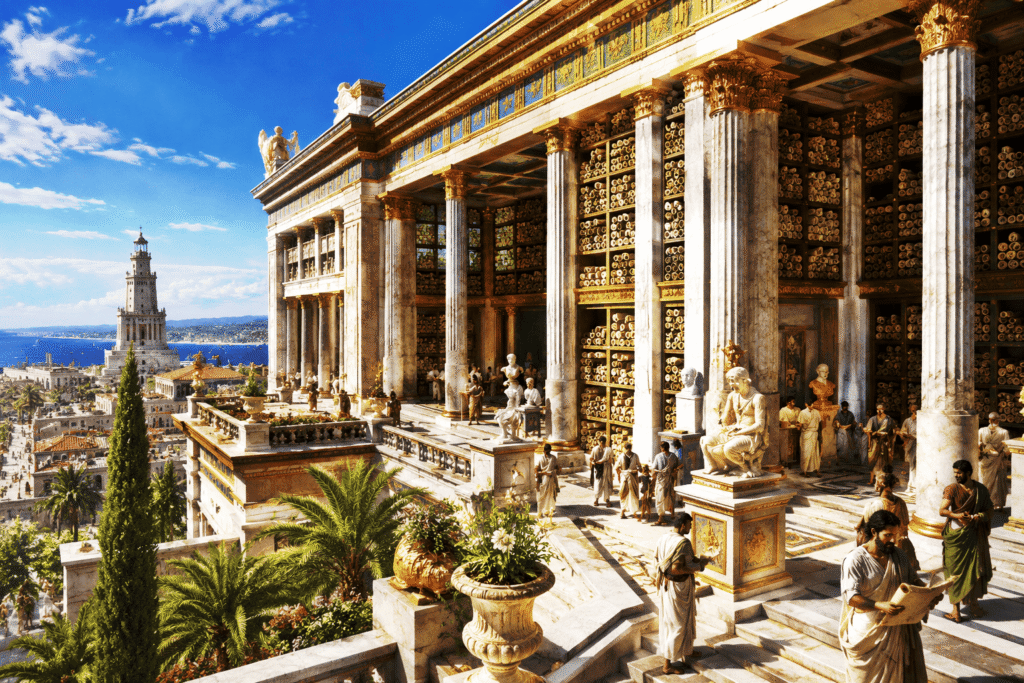
Then came the Library of Alexandria. More than two thousand years ago, during Egypt’s Ptolemaic dynasty, the rulers of Alexandria set themselves an enormous goal: gather as much of the world’s knowledge as possible in one place. Scholars came there to study, write, translate, teach, and argue with one another, because scholars have apparently been doing that forever. The collection included works dealing with science, mathematics, medicine, philosophy, literature, geography, astronomy, and many other subjects.
Ancient accounts say officials took collecting very seriously. Ships arriving in Alexandria could be searched for books and scrolls so texts could be copied and added to the collection. Exactly how every part of that happened is still debated, but Alexandria unquestionably became one of the ancient world’s great centers of learning. Its destruction is also more complicated than the story most of us grew up hearing. There probably wasn’t one enormous fire that suddenly wiped the entire library from existence in a single night. Alexandria endured wars, political changes, fires, and long periods of decline. Parts of its collections were likely damaged or lost at different times until eventually the great library was gone. Nobody knows exactly what disappeared with it.
That’s a painful little theme that keeps showing up throughout the history of libraries. Knowledge can be preserved for centuries and then disappear. Wars have burned libraries. Governments have destroyed books they didn’t want people reading. Religious conflicts have wiped out writings. Fires, floods, insects, moisture, and plain old neglect have finished off plenty more. Sometimes only one copy of something existed. Lose that copy and it wasn’t simply an old object that disappeared. A human voice disappeared with it.
After the fall of the Western Roman Empire, Europe went through centuries of political and social change, and books were expensive things to make. Every copy had to be written by hand. There was no machine in the next room cranking out another thousand copies. One book could take months or even years to produce. Monasteries became important places for preserving written works. Monks copied books by hand, sometimes working in rooms called scriptoria. Religious texts were obviously important, but monasteries also helped preserve some works from ancient Greece and Rome. Every page took patience. Letters were carefully formed, manuscripts might be decorated with elaborate illustrations and gold, and mistakes were not fixed by hitting Backspace.
Books could become so valuable that some libraries actually chained them to desks or shelves. That sounds insane now. Imagine walking into your local library and finding the history section chained to the furniture. But a handmade book could represent hundreds of hours of work and extremely expensive materials. A medieval library containing only a few hundred books could still be an important collection. Losing one mattered. Europe wasn’t the only place preserving and expanding knowledge.
During the Islamic Golden Age, cities such as Baghdad became major centers of scholarship. Scholars collected and translated works from Greek, Persian, Indian, and other traditions while studying and expanding mathematics, astronomy, medicine, philosophy, and science. The House of Wisdom in Baghdad became famous for its association with scholarship and translation. This is one of the parts of library history that I think gets overlooked. Knowledge has never politely stayed inside one country or civilization. It moves. Somebody writes something in one language. Somebody else translates it. A mathematical idea travels hundreds of miles. A medical text survives because people from another culture decide it is worth copying. Sometimes the person preserving an idea lives centuries after the person who originally had it.
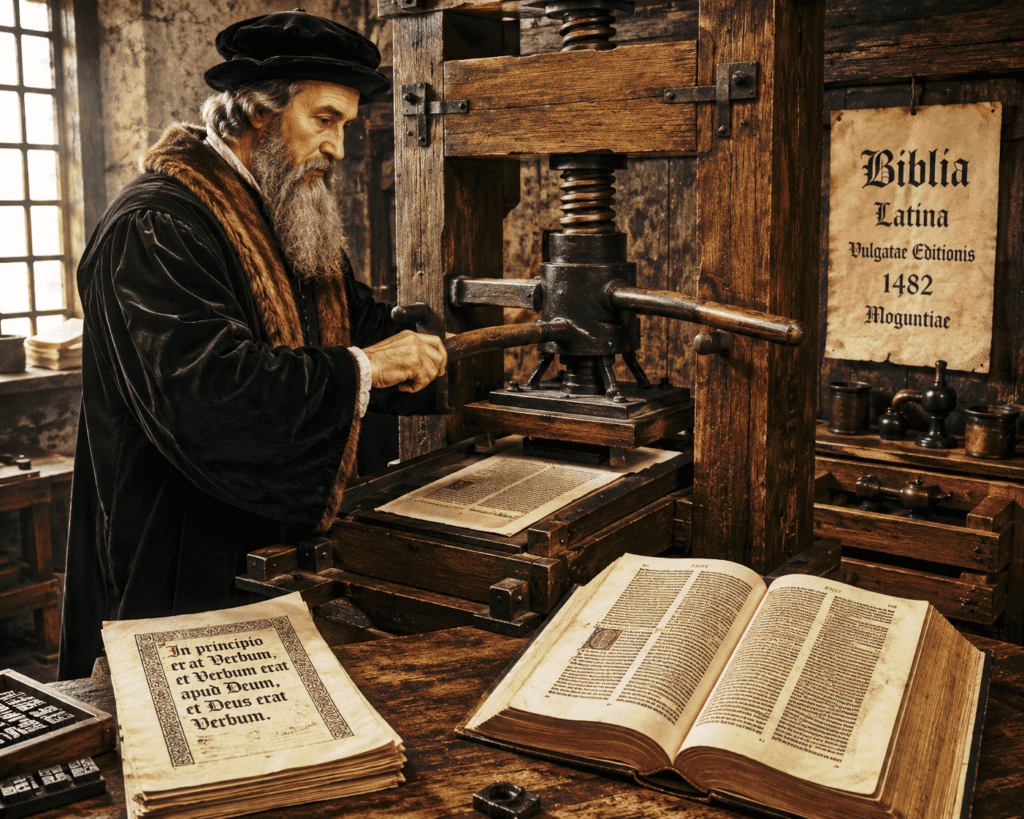
Libraries became meeting places for people who would never meet. Then the printing press came along and kicked the door open. Johannes Gutenberg is closely associated with the development of movable-type printing in Europe during the middle of the fifteenth century. Instead of somebody sitting there copying an entire book by hand, printers could arrange reusable letters, apply ink, press them onto paper, and make copies of the same page again and again. Books didn’t suddenly become cheap. But they became faster to produce, and over time the cost came down. More books were printed. More people could own them. More people learned to read. Universities expanded their collections and private libraries grew. Most importantly, information started moving through society faster.
When books were rare and brutally expensive, access to written knowledge naturally concentrated around governments, churches, universities, and wealthy people. Printing started putting cracks in that wall. An idea that once might have reached a handful of people could eventually reach thousands. Of course, making more books created another problem. Now where the hell did we put that one book?
Owning ten thousand books isn’t terribly useful if nobody can find the one they’re looking for. Libraries needed catalogs and better ways to organize their growing collections. Books began being grouped by subject, author, and title. Eventually systems such as the Dewey Decimal Classification, developed in the nineteenth century, helped libraries arrange books in ways readers could actually navigate. At the same time, the idea of who a library was for began changing.
Libraries had traditionally been associated with rulers, religious institutions, universities, scholars, and wealthy collectors. Public libraries pushed in another direction. A person didn’t have to own a private collection to have access to books. A child from a poor family could walk through the same door as somebody with money. Workers could teach themselves new skills. Immigrants could work on a new language. Students could study. Somebody who woke up one morning curious about history, science, mechanics, or art could simply go looking for it.
Public libraries expanded rapidly in the United States during the nineteenth and early twentieth centuries. Andrew Carnegie became one of the biggest names connected with that growth. After making his fortune in steel, Carnegie donated enormous amounts of money toward building libraries. More than 2,500 Carnegie libraries were built around the world. Communities generally provided the land and agreed to support their libraries after they were built. For millions of people, the library became an ordinary part of town. Maybe ordinary undersells it.
Walk into an older public library and there’s a certain feeling to the place. Tall shelves, old tables, reading lamps, and that particular kind of quiet libraries seem to have. Generations of people may have sat at those tables doing homework, reading newspapers, researching family history, or disappearing into a novel for a couple of hours. For much of the twentieth century, if you needed information, there was a pretty good chance somebody told you to go to the library. School report? Library. Want to repair something? There’s probably a book about it. Learn another language? Try the library. Need an encyclopedia? Fine, but you might need an entire shelf.
Then computers showed up. At first they helped libraries manage their own collections. Those enormous card catalogs filled with little paper cards and wooden drawers slowly started disappearing. Instead of digging through drawer after drawer, readers could type an author’s name or book title into a computer. Then the Internet arrived, and suddenly libraries had a much bigger problem than replacing card catalogs. People could find enormous amounts of information without entering a library at all. Search engines returned answers in seconds. Newspapers moved online. Encyclopedias became websites. Universities put research on the Internet, and historical documents were scanned and made available digitally.
So people started asking the obvious question. Do we still need libraries? Turns out we do. Libraries changed instead of disappearing. Modern libraries aren’t simply rooms filled with books anymore. Many provide computers, Internet access, digital research tools, job-search assistance, educational programs, meeting rooms, children’s activities, and classes. Some lend tools, musical instruments, electronics, and other equipment. Libraries can also provide access to databases that would cost an individual quite a bit of money to use independently.
Then there’s the eBook, which did something that would have sounded completely ridiculous to an ancient librarian. You can borrow a book from a library without going to the library. Sit on your couch. Open an app. Borrow the book. Start reading. The library can be ten miles away and locked up for the night. Doesn’t matter.
Think about the road we took to get there. A clay tablet had to be physically carried. So did a papyrus scroll. A handwritten manuscript had to be carried. A printed book had to be carried. Now thousands of books can travel inside a device that fits in your hand. Different technology. Same basic idea. Somebody created information. Somebody thought it was worth saving. Somebody organized it. Eventually somebody else came looking for it.
Libraries also protect something we’re very good at taking for granted: the past. Old newspapers, letters, maps, photographs, government documents, books, and manuscripts survive because somebody bothered to preserve them. Increasingly, those materials are being digitized too. A document that once required traveling hundreds of miles and getting special permission to examine can sometimes be viewed from a computer at home.
Digital doesn’t automatically mean permanent, either. Websites disappear. Files become obsolete. Hard drives fail. Companies close and online services vanish. We create staggering amounts of information, but somebody still has to decide what should be saved, organize it, protect it, and help people find it later. In other words, we still need librarians.
The tools have changed over thousands of years. Clay tablets became papyrus scrolls. Scrolls gave way to bound books. Handwritten manuscripts eventually shared the world with printed books. Card catalogs became computer databases. Now entire collections can exist digitally. But the job underneath all of that hasn’t changed nearly as much. Preserve what we know and help somebody else find it.
There’s another reason I think libraries have lasted so long. You can walk into one without knowing what you’re looking for. Maybe you leave with a mystery novel, a book about ancient Egypt, instructions for fixing an engine, and something about the Civil War that caught your eye on the way out. Nobody asks why. Nobody expects you to buy the chair you’re sitting in. You’re simply allowed to be curious. That’s a pretty powerful idea.
Libraries have survived wars, fires, collapsing empires, religious conflicts, political revolutions, the printing press, radio, television, computers, and the Internet. Every time another technology appeared, somebody probably announced that libraries were finished. They’re still here.
Maybe that’s because a library was never really about the building or the shelves. It wasn’t even entirely about books. Libraries are about preserving what we know and making it available to whoever comes looking next. Thousands of years ago, that might have been a scribe searching through clay tablets. Later it could have been a scholar unrolling a papyrus scroll in Alexandria. A monk might have opened a handwritten manuscript by candlelight. A student in 1950 could have searched a card catalog.
Today somebody can type a few words into a computer and open a document written on the other side of the world. Different people. Different tools. Same purpose. Somewhere, somebody wrote something down because they thought it mattered. Somebody else decided it was worth keeping. Eventually, somebody came looking for it.