The Written Word, Dying Or Evolving
For thousands of years, the written word has been our primary method of preserving knowledge. From cave paintings and clay tablets to books. Now we have digital screens.
Is The Written Word Dying? It’s Evolving
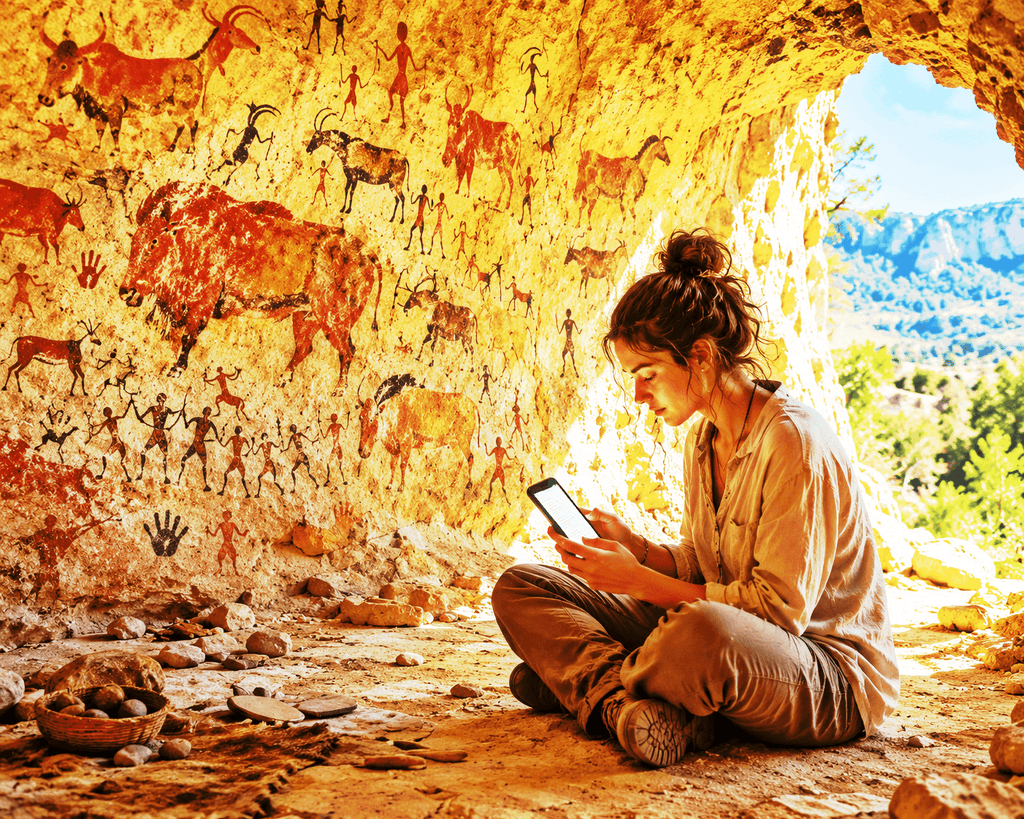
In just a few short years the majority of the planet has the internet, a smartphone and tablets. The cheapest smartphone today is more of a computer with more memory and speed than the home computers of the 80’s and 90’s. Now people keep their entire music collections and all of the books they read. Today we are bombarded with video, social media, podcasts and don’t forget AI. From cave paintings and clay tablets to books, and now digital screens. Many devices come with, or can be upgraded to be language translators. Making communication with people all over the planet with the touch of a button. Pretty cool or pretty overwhelming?
The way we consume information is changing worldwide. It’s a pretty big deal when you think about it. The written word built our civilization, ancient libraries filled with scrolls and books, religious texts, historical records, laws. Books preserved our knowledge across generations. One of the most famous ancient libraries was the Library of Celsus in Ephesus, located in what is now modern-day Turkey. Built around 110–135 AD, it reportedly held thousands of scrolls and served as a center of learning in the Roman Empire. Libraries have been preserving knowledge for nearly two thousand years, and despite all the technological changes since then, they are still with us today.
But here is the interesting part. The written word isn’t disappearing, it’s adapting. Every time a new technology came along, people predicted the end of reading. Radio was going to replace books. Television was going to replace books. Then computers, the internet, and eBooks were supposed to finish the job. Yet here we are, thousands of years after the first written records, and people are still reading.
The Digital Revolution
The format may change, but the need for stories and information remains the same. A novel can now live on a bookshelf, a Kindle, a tablet, a smartphone, or even be listened to as an audiobook while driving to work. The words are still there. The delivery system has changed. Will bookstores turn into Blockbuster Video Stores? I’d bet there are many young adults who don’t even know what a Blockbuster Video was. They are only in 80’s movies now. What about book stores.
I read a lot, mostly for pleasure at least one word, book a week and in between I don’t even count the technical manuals or software manuals I read, a bunch. In the 80’s I would drive to Barnes and Noble and buy a new mystery, sci-fi or a fantasy or two, just for that written word. I did a little research on Barnes and Noble and they are doing just fine. I’m glad because if book stores are okay then our libraries will be okay too. For now at least, who knows what the next 20 years will bring. What concerns me isn’t whether books will survive. I think they will. What concerns me is our attention span.
We live in a world of notifications, short videos, endless scrolling, and information overload. Sometimes it feels like everyone is competing for the next ten seconds of our attention. Reading requires something different. It asks us to slow down, focus, and spend time with an idea. Maybe that’s why books still matter. They give us something that social media can’t.
A good book allows us to escape for a while, learn something new, or see the world through someone else’s eyes. Whether it’s a mystery novel, a fantasy adventure, a history book, or a biography, books let us experience things we might never encounter in our own lives. As a mystery writer, I may be a little biased, but I still believe there is something special about getting lost in a good story. If you’d like to read mine, you can download a free copy of In Plain Sight here.
Just a few things that the digital revolution has brought us:
- The Internet
- smartphones
- PCs (Personal Computers)
- Tablets
- eBooks
- Video Streaming
- Emails
When I was in high school, and I needed to write a paper on a topic that I didn’t know anything about. That was every paper I was assigned to write, I went to the World Book Encyclopedia to get what word I needed. For the very young the Encyclopedia was a series of hardbacked large heavy books for each letter of the alphabet. People made a living selling these books, they weren’t cheap. We were fortunate to
have a set, but many of the kids I went to school with did not. My friends that didn’t would come over and do research at our house. Those salesmen are out of business now because we have search engines and AI.
When I was in high school, and I needed to write a paper on a topic that I didn’t know anything about. That was every paper I was assigned to write, I went to the World Book Encyclopedia to get what word I needed. For the very young the Encyclopedia was a series of hardbacked large heavy books for each letter of the alphabet. People made a living selling these books, they weren’t cheap. We were fortunate to have a set, but many of the kids I went to school with did not. My friends that didn’t would come over and do research at our house. Those salesmen are out of business now because we have search engines and AI.
Our smartphones have more access to information than those books and most libraries as well. When I wanted to ask a girl out in high school I had to ask her in person, or call her on the telephone. The kind of a phone that is attached to the wall by a cord, and if you have some gray hair you might even remember the rotary phones.
We had those when I was little, and ours came with a party line. When several households shared the same telephone line, you sometimes had to wait for your neighbors to finish their call before you could use the phone. One of the families on our line spoke Italian. Listening in on their conversations helped keep me fluent until the fourth grade. The world has grown up some since the 1960s.
How Our Reading Habits Are Changing
Printed books versus eBooks. Like I mentioned earlier, Barnes & Noble is a bookstore that shows no signs of weakening or closing stores despite stiff competition from Amazon. Amazon is the world’s largest seller of eBooks, printed books, and audiobooks.
What’s interesting is that both companies continue to thrive. Some readers still prefer the feel of a printed book in their hands, while others enjoy carrying an entire library on a Kindle, tablet, or smartphone. Audiobooks have added another option, allowing people to enjoy a good book while driving, exercising, or doing chores around the house.
The format may be changing, but people are still reading. They’re simply choosing different ways to consume the same stories and information. Reading on your phone, tablet, or e-reader is convenience over tradition. A single device can hold thousands of books and fit in your pocket.
The real question may not be whether we are reading less, but how deeply we are reading. There is a difference between consuming information and truly understanding it. Reading a social media post is not the same as reading a novel, word by word. Skimming headlines is not the same as studying a subject. The internet gives us access to more information than at any other time in history, but it is up to us to decide how much of it we actually absorb.

What about our libraries? Will they still be here in 20 years? Fifty years? I’m going with yes. Libraries have always adapted to new technology. They went from scrolls to books, from card catalogs to computers, and now many offer eBooks, audiobooks, online research tools, and free internet access. Libraries, like the rest of us, are evolving and adapting to how we take in information. As long as people want to learn, discover, and explore new ideas, I think libraries will continue to find a way to serve their communities.
AI And The Future Of Learning
AI can access information almost instantly. I work with OpenAI ChatGPT, which I named Charlie, and he’s helping me with some of the facts on this page right now. AI has become my research assistant. Forget games like Trivial Pursuit. With AI, you’d win every time.
But believe it or not, AI is not always right. You should still double-check your research. AI gives us access to information faster than ever before, but there is a difference between getting a quick summary and tracking down information from original sources. The speed is impressive, but accuracy still matters.
Why Books Still Matter:
- Books encourage deeper concentration.
- Fiction develops imagination and empathy.
- Long-form reading improves understanding.
- Books allow readers to explore complex ideas.
- Some experiences cannot be reduced to a short video clip.
I have lived through a lot of technological changes in my lifetime. I grew up with rotary phones, party lines, encyclopedias, and libraries filled with card catalogs. If I wanted information, I had to go find it. Today I can pull a smartphone out of my pocket, ask a question, and have an answer in seconds. I can read a newspaper from another country, download a book instantly, listen to an audiobook while driving, or use AI to help research a topic. That kind of technology would have seemed like science fiction when I was a kid.
Yet for all the changes, some things remain the same. People still want to learn. We still tell stories. We still search for answers, share ideas, and pass knowledge to the next generation. The tools have changed, but the human need for information, entertainment, and understanding has not.
Will books look different in the future? Probably. Will more people read on screens than on paper? Most likely. Will AI become an even bigger part of education and research? I think so. But I don’t believe the written word is going anywhere. It has survived every major technological shift for thousands of years, and I suspect it will survive this one too.
The written word isn’t dying. It is adapting, just as it always has. From cave walls to clay tablets, from printed books to digital screens, each generation has found a new way to preserve and share knowledge. What matters is not the format. What matters is that we continue to read, learn, think, and question the world around us. As long as we do that, the written word will remain one of humanity’s most powerful tools.